by Kristen Goodhue

In a low-lying forest at the Smithsonian Environmental Research Center (SERC), a team of scientists are quietly predicting the future. For three summers, they’ve flooded the forest with brief deluges of freshwater and saltwater. They’re mimicking the heavy downpours and storm surges expected as more extreme weather batters the East Coast. Their mission: Find out why storms can make forests stress out, and how much stress a forest can take before it begins turning into a ghost forest.
This fall they released initial results, in a new study in the Proceedings of the National Academy of Sciences. Hints of a forest going ghost can materialize in just two years. And the transformation begins underground, in the soil.
“These systems could begin to change even before you can see them changing,” said Pat Megonigal, SERC biogeochemist and senior scientist who helped create the project.
But if scientists know what the early warning signs are, there’s a greater chance they could help some forests before it’s too late, according to Peter Regier, lead author and Earth scientist at Pacific Northwest National Laboratory (PNNL).
“We can shift from reacting to dead trees to proactively targeting restoration and resilience strategies for forests at risk of flooding as seas rise and storms intensify,” Regier said.
Manufacturing A Tempest

The project goes by the name TEMPEST. It’s short for “Terrestrial Ecosystem Manipulation to Probe the Effects of Storm Treatments.” In other words, it’s a real-time weather experiment covering a very large tract of land—not the type of experiment confined to a lab. It’s part of an even larger project called COMPASS-FME, which aims to predict transformations throughout the coastal zone. That includes predicting the fate of coastal forests.
“They stabilize landscapes,” said Vanessa Bailey, project co-lead and Earth scientist at PNNL. “Those root systems are really important for keeping soil from eroding. At some point when the forest dies, all of that surface soil becomes highly erodible.”
However, the best Earth science predictions today don’t have much intel on ghost forests, much less what the early warning signs look like. To make better predictions, scientists need better data.
“One of our colleagues asked, what if we flooded a forest? What if we completely simulated a massive flooding event?” Bailey said.
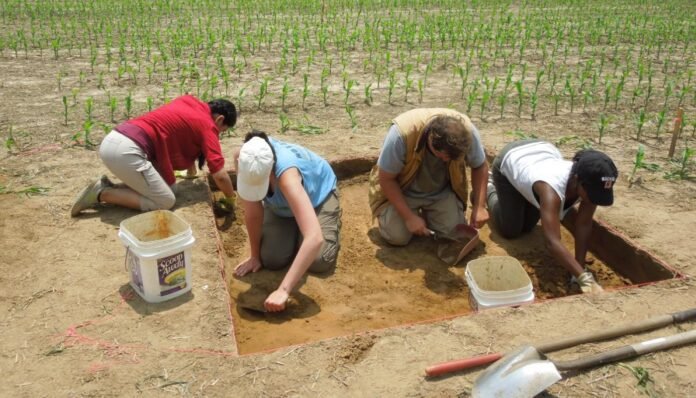
In 2020, when many other projects shut down due to the pandemic, the TEMPEST team began laying the groundwork. They divided the SERC forest into two 2,000-square meter plots, one to test freshwater and one to test saltwater. Narrow black irrigation lines crisscross each plot, with roughly 200 sensors strapped to the trees and buried in the soil. During flooding events, the irrigation lines send up hundreds of sprinklers along the forest floor. Nearby, another 2,000-square meter forest plot sits undisturbed for comparison. The team also collected plenty of baseline data on what the forest was like pre-flooding.

The experiment kicked off in summer 2022. For a single day, they flooded one forest plot with 80,000 gallons of freshwater and its neighbor with 80,000 gallons of saltier water from the Rhode River, a tributary of Chesapeake Bay. That translates to about 6 inches of water added across the entire experiment—roughly the same levels of rainfall Hurricane Sandy dumped on Annapolis in 2012.
“The team went all in,” said Anya Hopple, a former PNNL postdoc who worked on TEMPEST at its beginning. “People were waking up before dawn to measure how trees were responding, running resistivity surveys around the clock, camping on site and tracking greenhouse gas fluctuations for days and weeks afterwards.”
The next year, they repeated the process for two days in a row. (They ran the experiment for three consecutive days in 2024, but those data aren’t included in the recent study.) In 2025 they gave the forest a break. They plan to pick things back up next summer.
Ghost Forest Underground

The new study reported findings from the second year of the TEMPEST experiment, when the team ran two back-to-back flooding events. In the soil, early warning signs of a ghost forest emerged almost immediately.
Saltwater flooding showed some of the most extreme impacts. From a forest’s perspective, a saltwater flood isn’t that different from a drought, according to Megonigal.
“Salt tends to starve the tree of water,” Megonigal said. “It makes it harder for the tree to draw water out of the soil.”
The effects of saltwater flooding lasted longer than the team expected. Soil conductivity—a method of estimating the soil’s saltiness—ratcheted up over 19 times higher during the saltwater flood. Five days later, the soils still hadn’t recovered. Soil conductivity remained over 10 times higher than before.
Oxygen in the soil dropped as well, though it recovered more quickly. By the second day of flooding, both plots had plummeted to less than 1% of their normal oxygen levels. Within three days after flooding stopped, however, they had bounced back to almost pre-flood oxygen levels.
But oxygen loss had a more subtle effect that lingered. In the freshwater plot, isolated pockets of soil remained devoid of oxygen even after oxygen levels in other areas of the soil had rebounded. Even though trees emit oxygen from leaves, they also need oxygen from soil air around their roots to respire.
“When you flood the soil, and you cut it off from the atmosphere, now these roots are vulnerable to essentially being suffocated,” Megonigal said.
Ghosts in the Trees

Ultimately, whether a ghost forest emerges depends on the trees. Three tree species dominate the TEMPEST forest: beech, red maple and tulip poplar. And each species had a different reaction to the flooding.
The scientists measured the trees’ health through sap flux, or how fast water moves through the trees. It’s a bit like taking a tree’s pulse.
“Just like a person’s pulse or heart rate tells you something about how healthy they are, the rate at which water’s moving through the tree tells you something about how healthy it is,” Megonigal said. “And if it starts to decline, then it means that something’s wrong.”
Beeches showed the most resilience. Their sap flux increased under both freshwater and saltwater floods. Meanwhile, red maples and tulip poplars saw their circulation slow down. Tulip poplars suffered the most, especially in the saltwater plot. Even more striking, tulip poplar leaves in the saltwater plot turned brown about two months earlier in the fall than the other trees.
“Detecting species-specific declines in sap flux after just our second year of flooding treatments was earlier than we anticipated,” Regier said. “It definitely highlights how limited our understanding is of the mortality thresholds for coastal forests experiencing flooding.”
Knowing that some trees are more resistant to ghost forest triggers could help managers predict which coastal forests could be saved, or which trees to plant in future forest restorations or timber plantations.
The TEMPEST team is already preparing for the next summer of flooding in 2026. Ideally, the researchers hope the experiment will last a full decade. Because in an environment as long-lived as a forest, two years of data usually don’t tell the whole story.
“We know that ecosystems don’t behave linearly,” Bailey said. “The question is, are the responses we see going to taper off, or are the responses we see going to hit a threshold that shifts the whole ecosystem into a different state?”
The University of Toledo and Global Aquatic Research LLC also contributed to this study. The research article, “Short-term experimental flooding impacts soil biogeochemistry but not aboveground vegetation in a coastal forest,” is available online at https://doi.org/10.1073/pnas.2511756122.